The Statue and Its Subject
The bronze statue of Edward Colston stood in The Centre, Bristol, from 1895 until 2020. Created by Irish sculptor John Cassidy, it depicted a man whose name had long been associated with local philanthropy; almshouses, schools, hospitals and churches across the city bore his name. Yet Colston was also a senior executive of the Royal African Company between 1680 and 1692, a period during which the company transported an estimated 84,000 enslaved Africans, including 12,000 children, from West Africa to the Americas. More than 19,000 of those people died en route. The statue was listed Grade II in 1977, but by the late twentieth century its subject's role in the transatlantic slave trade had become increasingly difficult to ignore.
The Events of 7 June 2020
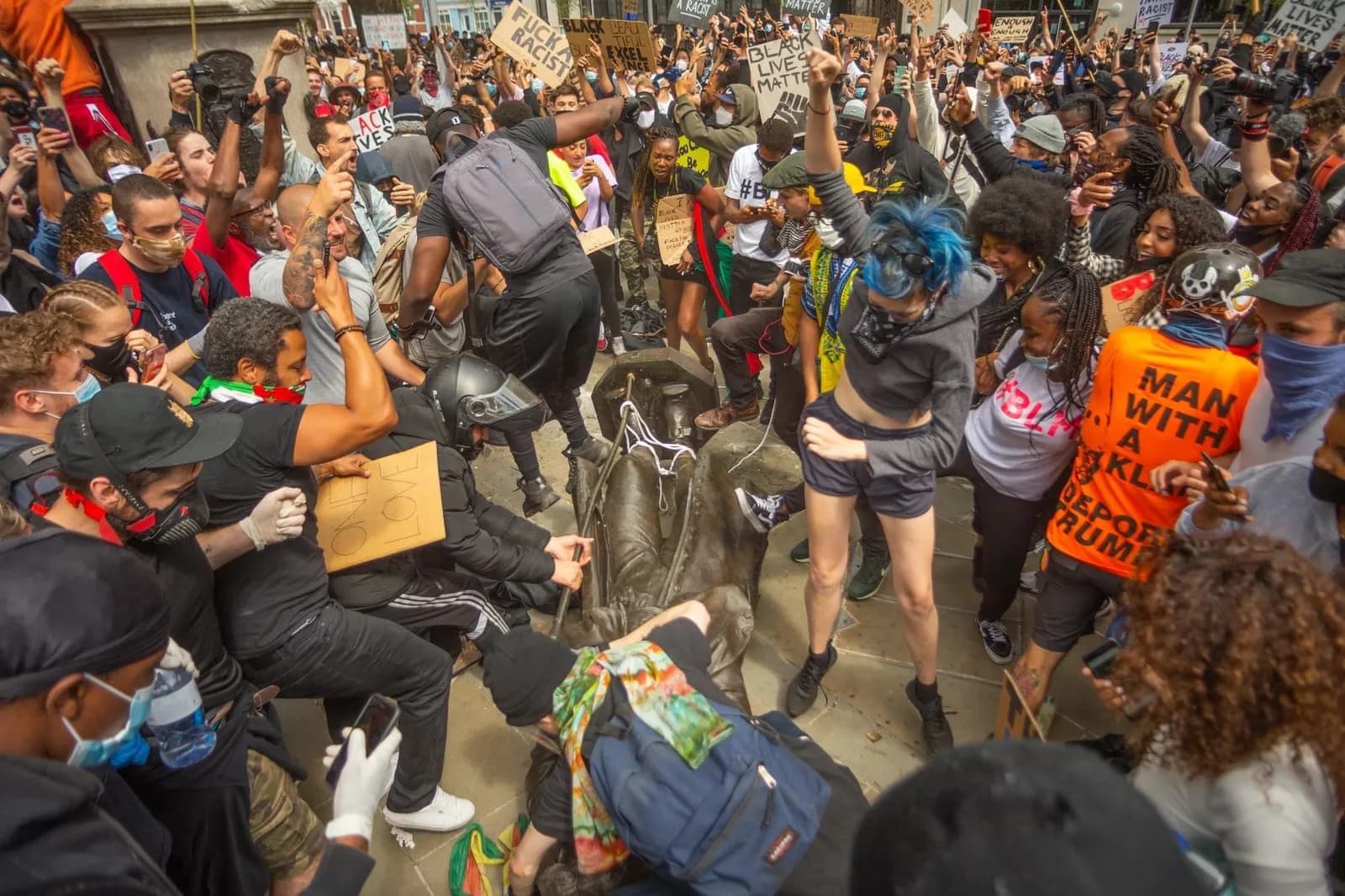
On 7 June 2020, during a Black Lives Matter protest that formed part of the global response to the murder of George Floyd, demonstrators surrounded the statue. Protesters daubed it in red and blue paint; one knelt on its neck in a gesture that referenced George Floyd's death. The crowd then pulled the statue from its plinth, rolled it down Anchor Road and pushed it into Bristol Harbour. Superintendent Andy Bennett of Avon and Somerset Police later explained that officers had made a "tactical decision" not to intervene, fearing that confrontation could escalate into further violence or a riot. Police nevertheless confirmed that the act constituted criminal damage and that an investigation would follow.
Years of Local Campaigning
The toppling did not emerge from nowhere. Controversy had intensified since the 1990s as Colston's slave-trading activities became more widely known. In January 1998, the words "SLAVE TRADER" were painted on the statue's base. In 2013, Bristol's first elected mayor, George Ferguson, publicly questioned the city's annual celebration of Colston, calling it "perverse." In August 2017, sculptor Will Coles attached an unauthorised plaque to the plinth memorialising the enslaved; Bristol City Council removed it two months later. The council then proposed an official second plaque, but the wording became controversial after the Society of Merchant Venturers edited it. Mayor Marvin Rees vetoed the plaque in March 2019, stating he had not been consulted and criticising the Society's interference.
Aftermath and Retrieval
The statue remained submerged for four days. On 11 June 2020, Bristol City Council retrieved it from the harbour. It was caked in mud and sediment, missing a coattail and its walking stick, with damage to its left side and foot. During cleaning, conservators discovered an 1895 issue of Tit-Bits magazine tucked inside, bearing a handwritten date of 26 October 1895 and the names of those who had originally fitted the statue. The council announced that the statue would be preserved with its graffiti and ropes intact, and would eventually be exhibited in a museum.
The Colston Four Trial
On 9 December 2020, four individuals; Rhian Graham, Milo Ponsford, Jake Skuse and Sage Willoughby, were charged with criminal damage. They became known as the "Colston 4." They pleaded not guilty, and on 5 January 2022 a jury acquitted them. Their defence argued that the statue had not been damaged, or alternatively that its public display had itself been a criminal act, and that a conviction would represent a disproportionate interference with freedom of expression.
A City Renamed and Re-examined
The toppling accelerated changes that had already been gathering pace. Colston Hall was renamed Bristol Beacon, Colston's Girls' School became Montpelier High School, and Colston Primary School became Cotham Gardens Primary School. In September 2020, Mayor Marvin Rees established the We Are Bristol History Commission. The defaced statue was displayed at the M Shed museum from June to September 2021, and from March 2024 it became a permanent exhibit. On 17 April 2025, a new plaque was installed on the empty plinth. It removed the description of Colston as a "city benefactor" and explained that the statue had been removed because of his involvement in the transatlantic slave trade.
Reactions From Bristol and Beyond
Mayor Marvin Rees stated that the statue was an "affront" and that he felt no "sense of loss." He added: "We have a statue of someone who made their money by throwing our people into water ... and now he's on the bottom of the water." Superintendent Bennett acknowledged that Colston had "caused the black community quite a lot of angst" and described the toppling as "very symbolic." Nationally, then-Home Secretary Priti Patel called the act "utterly disgraceful" and "sheer vandalism." Labour leader Keir Starmer said the removal was "completely wrong" in its manner, but agreed the statue "should have been brought down properly, with consent, and put in a museum." The Society of Merchant Venturers, which had long defended Colston's legacy, stated on 12 June 2020 that "the fact that it has gone is right for Bristol" and acknowledged that its involvement in the plaque rewording had been "inappropriate."