In 1497, a 50-ton caravel named the Matthew departed from Bristol Harbour carrying an Italian navigator and a crew of eighteen men. Their voyage would establish England's first claim to North America and forever tie Bristol's maritime identity to the discovery of the New World.
The Navigator Who Came to Bristol
Giovanni Caboto, known to history as John Cabot, was born in Italy around 1450. He became a Venetian citizen in 1476, having resided in the republic for at least fifteen years. By 1488, however, Cabot had left Venice as an insolvent debtor, making his way through Valencia, Seville, and Lisbon before reaching England around mid-1495.
Although historians once believed Cabot travelled directly to Bristol seeking financial backing, recent research by Alwyn Ruddock suggests he initially went to London, where he secured support from the city's Italian community. This included Father Giovanni Antonio de Carbonariis, an Augustinian friar who helped connect Cabot with potential sponsors.
The Letters Patent of 1496
On 5 March 1496, King Henry VII granted Cabot and his three sons letters patent authorising the exploration of unknown lands. The terms of this grant were unusually specific: all expeditions had to depart from Bristol, and any commerce resulting from discoveries must be conducted solely with England, through Bristol alone.
This provision effectively created a monopoly port on the Iberian model, ensuring that Bristol merchants would control England's nascent Atlantic trade. The Bardi family, an Italian banking house based in London, contributed 50 nobles to the venture in March 1496. Bristol merchants provided additional backing, drawn from a city that was England's second-largest seaport in the 1490s.
The Voyage of the Matthew
The Matthew, a caravel of Bristol, was a modest vessel by the standards of the day; contemporary accounts describe it as a "little ship." Its crew numbered either eighteen or twenty men, depending on the source. They set sail from Bristol on 2 May 1497.
Land was sighted on 24 June 1497, the feast day of St John the Baptist. Cabot went ashore and raised the banners of Venice and the Papacy, claiming the land for the King of England. According to contemporary accounts, he did not venture "beyond the shooting distance of a crossbow" from the shore. No contact with Indigenous people was reported, though the crew found evidence of habitation: remains of a fire, a human trail, nets, and a wooden tool.
The precise landing location remains disputed. Canada and the United Kingdom officially designated Cape Bonavista in Newfoundland as the site for the 500th anniversary in 1997, though some historians argue for a location near modern-day St John's. The Matthew returned to Bristol on 6 August 1497, completing a voyage of just over three months.
Why Bristol?
Bristol was not chosen arbitrarily. The city possessed both the maritime infrastructure and the exploratory tradition necessary for such an undertaking. By the 1490s, Bristol's customs accounts showed trade growing strongly, largely due to increased commerce with Spain.
More significantly, Bristol merchants had been venturing into the Atlantic since at least 1480, funding expeditions in search of the mythical island of Hy-Brasil. Professor David Beers Quinn of the University of Liverpool suggested that these pre-Cabot voyages may have reached the Grand Banks off Newfoundland, where Bristol fishermen subsequently developed a lucrative cod fishery.
The city's maritime history stretched back centuries. By the mid-14th century, Bristol was England's third-largest town after London and York, with a population of 15,000 to 20,000 before the Black Death. Its merchants traded extensively with Gascony, Bordeaux, Ireland, Portugal, and from around 1420 to 1480, maintained a regular trade with Iceland for stockfish. In 1373, Edward III had proclaimed Bristol a county in its own right, separate from Gloucestershire and Somerset, recognising its distinct civic identity.
The Legacy of the 1497 Voyage
Cabot's expedition was the earliest known European exploration of coastal North America since the Norse visits to Vinland in the 11th century. It provided the basis for English claims to the continent that would eventually support the establishment of permanent colonies.
The voyage also initiated a sustained period of English engagement with the New World. In 1499 or 1500, William Weston of Bristol led the first English-led expedition to the "new found land." Cabot's son Sebastian explored the North American coast in 1508–09. Around 1503–04, Bristol-based explorers formed a formal company under letters patent: the Company Adventurers to the New Found Land.
Yet the immediate impact should not be overstated. Cabot failed to find the northwest passage to Asia that he sought. What he discovered was cod; an abundant resource that proved profitable for Bristol merchants but did not transform England's position in global trade overnight.
Memorialising the Voyage in Bristol
Bristol has repeatedly returned to Cabot's voyage as a source of civic pride. Cabot Tower, a 105-foot red sandstone structure on Brandon Hill, was built between 1897 and 1898 to commemorate the 400th anniversary. Its foundation stone was laid on 24 June 1897 by the Marquess of Dufferin and Ava. The tower cost £3,250, raised by public subscription, and was designed by architect William Venn Gough. Three commemorative plaques adorn its base; one reads: "This tower was erected... to commemorate the fourth centenary of the discovery of the continent of North America, on June 24, 1497, by John Cabot, who sailed from this port in the Bristol ship Matthew."
The tower was restored between 2007 and 2011 at a cost of £420,000 and reopened on 16 August 2011. It remains a Grade II listed building and a visible reminder of Bristol's connection to the New World.
A bronze statue of John Cabot by Stephen Joyce has stood at Bristol Harbourside since 1985; an earlier statue from 1952 is located at City Hall.
The Matthew Today
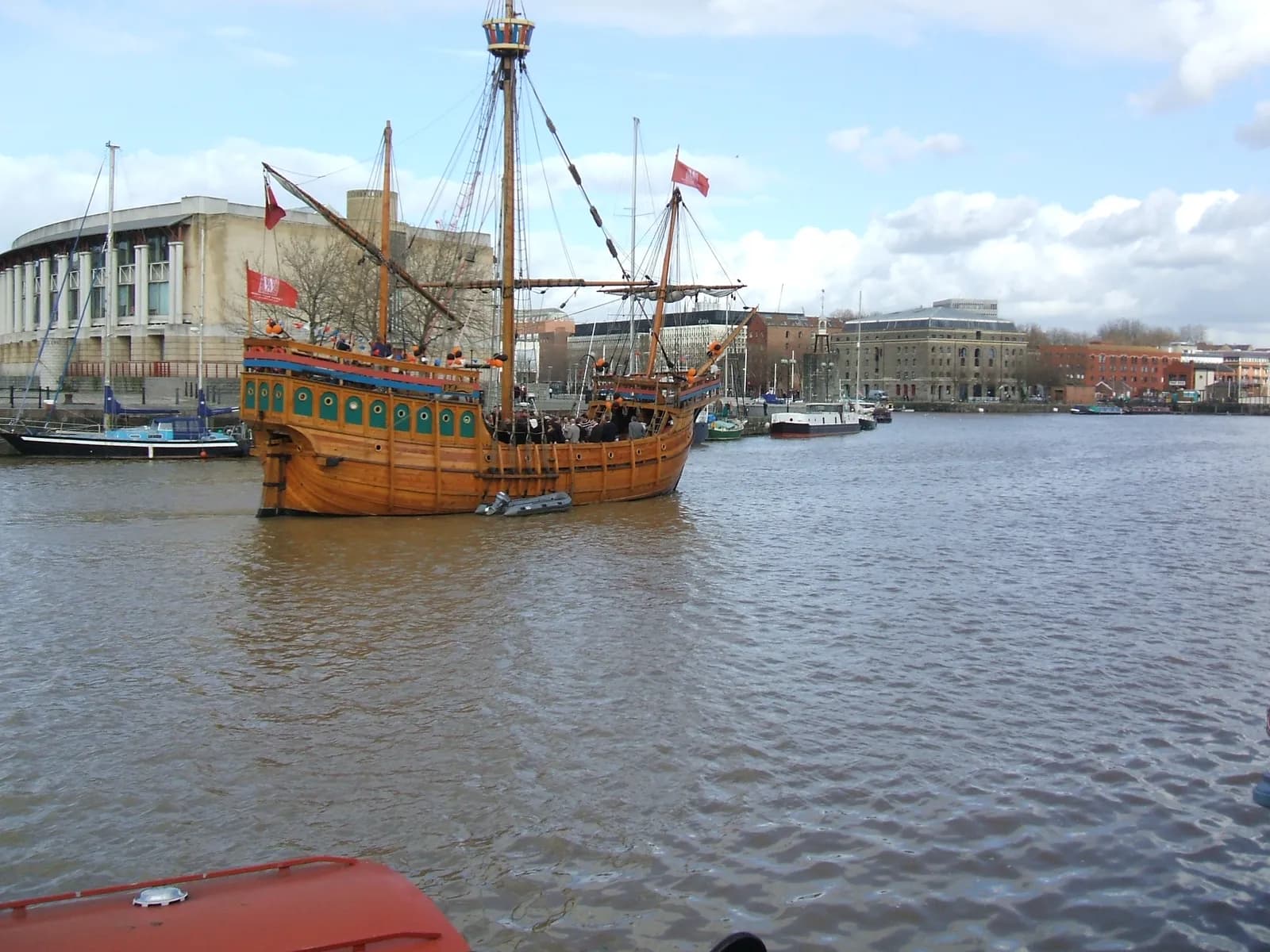
The most vivid connection to 1497 is the Matthew itself; or rather, a faithful reconstruction built between 1994 and 1996 at a cost of £3.8 million. Designed by naval architect Colin Mudie and constructed by Storms'l Services, the replica measures 78 feet in length with a beam of 20 feet 6 inches. Built from oak and Douglas fir, she carries 2,360 square feet of sail, though she also carries modern additions: a diesel engine and ship radio.
Launched in 1996 and dedicated during the first International Festival of the Sea, the replica Matthew retraced Cabot's journey for the 500th anniversary in 1997. She was welcomed into Bonavista by Queen Elizabeth II on 24 June that year.
Today, the Matthew is owned by The Matthew of Bristol Trust, a registered charity, and is normally moored outside M Shed museum on Princes Wharf. She continues to sail, offering educational trips and public excursions that keep Bristol's maritime heritage accessible and alive. In 2012, she took part in the Queen's Diamond Jubilee pageant on the River Thames.
What Remains Unclear
The precise landing location in North America remains disputed; Cape Bonavista is the officially recognised site, but the actual location may have been elsewhere on the Newfoundland coast. The extent of Cabot's exploration once ashore is also uncertain; contemporary accounts suggest he did not travel far inland.