The Problem of the Severn Tide
Before 1809, Bristol's prosperity was at the mercy of one of the world's most extreme tidal ranges. The River Avon and River Severn experience tides fluctuating approximately 47 feet (14 metres) between high and low water, leaving ships stranded on mudflats twice daily. Vessels were frequently grounded in a narrow, muddy channel, damaging cargoes and limiting the size of ships that could reach the port. The phrase "shipshape and Bristol fashion" originated from this era; it described ships and their secured cargo capable of withstanding repeated strandings on the Avon mud.
By the early 1800s, the limitations of Bristol's docks were causing serious problems for local business. Liverpool's expanding dock facilities were drawing trade away from Bristol, particularly in the lucrative tobacco trade. The city needed a radical solution if it was to remain a major maritime power.
William Jessop's Audacious Vision
William Jessop was one of Britain's foremost civil engineers when he turned his attention to Bristol's predicament. Born in Devonport, Plymouth, on 23 January 1745, Jessop had trained under the legendary John Smeaton, working on canal schemes across Yorkshire before establishing his own practice. His portfolio already included the Grand Canal of Ireland, the Cromford Canal, and the West India Docks in London. Jessop was known as a modest man who encouraged younger engineers, including Thomas Telford and John Rennie; he was not given to self-promotion but to solid, practical engineering.
In 1802, Jessop proposed an ambitious solution: a "floating harbour" created by damming the River Avon at Hotwells and installing a system of locks. The scheme would divert the tidal river through a new artificial channel, leaving the existing harbour basin with a constant water level. Parliament approved the plan, and the Bristol Docks Company was formed to execute it.
Construction of the Floating Harbour
Construction began at five o'clock in the morning on 1 May 1804, with directors of the Bristol Docks Company conducting the opening ceremony. The project was immense. Jessop's original plan proposed a shorter cut from Prince Street to Rownham, but this was amended to include a greater area of the River Avon, creating a 70-acre (28-hectare) harbour basin.
The centrepiece of the engineering works was the New Cut, an artificial watercourse approximately 1.8 miles (2.9 km) long that would divert the tidal Avon around the harbour. Excavation proceeded through Redcliffe Sandstone, a Triassic rock that tested the capabilities of early 19th-century engineering. In the first year alone, 780,625 cubic yards of earth and rock were removed at a cost of £120,138 12s. 1d. The initial budget of £300,000 proved insufficient; further parliamentary acts eventually raised the capital to £600,000, with the final cost reaching £530,000.
The Lock System at Cumberland Basin
Jessop designed Cumberland Basin as the main entrance to the docks, separating Hotwells from the tip of Spike Island. The basin featured two entrance locks from the tidal Avon, measuring 45 feet (13.7 metres) and 35 feet (10.7 metres) in width respectively. A third lock, 45 feet wide, formed the junction between the basin and the Floating Harbour itself.
This three-lock configuration provided operational flexibility that was ahead of its time. When traffic was heavy, the basin could function as a lock itself, allowing multiple ships to enter and exit efficiently. The quay walls and bollards constructed during this period remain and carry listed building status today.
At the eastern end of the harbour, Netham Lock marked the upstream limit where boats from the River Avon gained access to the Floating Harbour. This structure was also built in 1804 as part of Jessop's system.
Opening Day and Early Years
The River Avon was diverted into the New Cut in January 1809. On 2 April 1809, the first ships passed up the cut, and on 1 May 1809, exactly five years after construction began, the harbour officially opened.
The celebration was fitting for an undertaking of such scale. A dinner was held on Spike Island for 1,000 navvies, featuring two oxen roasted whole, a proportionate weight of potatoes, and six hundredweight of plum pudding. A persistent local myth has suggested that French prisoners of war formed part of the labour force, but no evidence supports this claim.
The Feeder Canal and Underfall Yard
The Feeder Canal stretched from Netham Lock to Totterdown Basin, providing a link to the tidal river so boats could continue upstream to Bath. The first mile from Netham was an artificial canal; downstream of Totterdown Basin, the Floating Harbour itself occupied the former natural course of the River Avon.
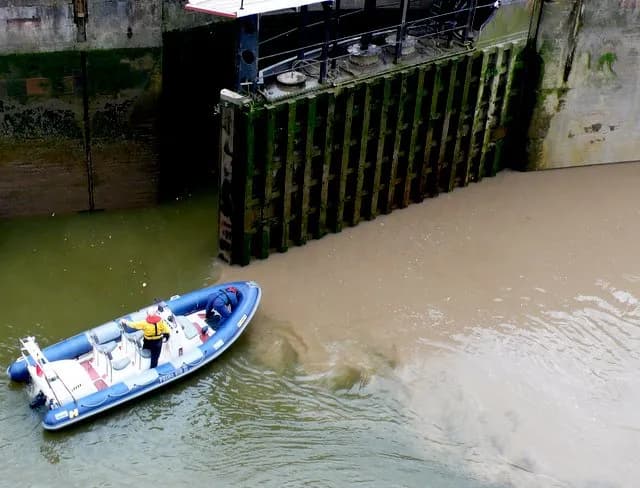
At the western end, Jessop constructed a dam at Underfall Yard with an "overfall" weir to allow surplus river water to flow into the New Cut. The yard was completed in 1809 under Jessop's direction. By the 1830s, the Floating Harbour was suffering from severe silting, and Isambard Kingdom Brunel was employed to devise a solution. Brunel constructed three shallow sluices to control water levels and one deep scouring sluice to remove silt. When the deep sluice is opened at low tide, a powerful undertow sucks silt out of the harbour into the river, where it is carried away on the next tide. The sluice system installed in the 1880s remains operational today and was computerised and automated in March 1988.
Economic Impact and Challenges
The Floating Harbour achieved its primary objective: ships could now remain afloat at all times, protected from the Severn's extreme tides. However, the project brought its own economic challenges. The harbour cost significantly more than anticipated, and the high rates levied to repay loans undermined the intended benefit of drawing companies back from Liverpool.
In 1848, Bristol City Council purchased the docks company to force down the rates. The Council employed Brunel to make improvements, including new lock gates, a dredger, and the underfall sluice system that addressed the persistent problem of siltation.
The Floating Harbour enabled the construction of revolutionary vessels within Bristol. The SS Great Western was built in 1838 at Patterson's yard within the harbour. In 1843, the SS Great Britain was launched; with a beam of 48 feet (14.6 metres), she was too large to pass through the harbour locks and remained in the Floating Harbour until December 1844. Ironically, the very success of Bristol's shipbuilding in producing ever-larger vessels hastened the decline of the city centre docks. By 1867, meanders in the River Avon prevented vessels over 300 feet (91 metres) from reaching the harbour.
The Harbour Today
The city centre docks continued to serve smaller trading ships until the early 1970s. Charles Hill & Sons, the last shipbuilder, closed in 1977 after delivering the MV Miranda Guinness. By then, the Royal Edward Dock had opened at Avonmouth in 1908, followed by the Royal Portbury Dock in 1972, taking over Bristol's commercial maritime operations.
The Floating Harbour has since transformed into a cultural and leisure destination. The 200th anniversary in 2009 was marked with a series of commemorative events. Today, the harbour attracts tourists to its museums, galleries, bars, and restaurants. The SS Great Britain is permanently berthed as a museum ship. The Matthew, a replica of John Cabot's 1497 vessel, is a familiar sight. The Arnolfini art gallery occupies a 19th-century Grade II* listed tea warehouse at Bush House, whilst the Watershed Media Centre fills another former warehouse.
The Bristol Harbour Festival, held annually in late July, attracts approximately 200,000 visitors. Ferry services operated by Bristol Ferry Boats and Number Seven Boat Trips provide transport along the water. Underfall Yard remains a working boatyard, maintaining harbour equipment and housing two active boat building companies.
The regeneration of Canon's Marsh, including Millennium Square and the We The Curious science centre, represents one of the most significant post-industrial transformations in Bristol. The £240 million regeneration programme was funded partly through £44.3 million from the National Lottery, alongside £43.4 million from the council and partners.
A Legacy of Engineering Excellence
William Jessop died on 18 November 1814 at Butterley Hall in Derbyshire, five years after his Bristol masterpiece was completed. His Floating Harbour remains a testament to early 19th-century engineering ambition. The system he designed, improved by Brunel's underfall sluices, continues to function more than two centuries later.
The Floating Harbour represents a pivotal moment in Bristol's history. It secured the city's position as a maritime power through the industrial age, enabled the construction of revolutionary ships, and provided the foundation for the waterfront destination that defines Bristol today.