Isambard Kingdom Brunel shaped Bristol's skyline and global reputation through three landmark engineering projects. Between the 1830s and 1850s, the city became the proving ground for innovations in rail, maritime, and civil engineering that altered travel and commerce across Britain and beyond.
Temple Meads and the Great Western Railway
Brunel was appointed engineer of the Great Western Railway and designed its London to Bristol main line. Bristol Temple Meads opened on 31 August 1840 as the western terminus, constructed on a viaduct to raise it above the Floating Harbour and the River Avon. The original station, built between 1839 and 1841, featured a 200-foot train shed and an office building in the Tudor style, accommodating Brunel's broad gauge of 7 ft 1/4 in. Train services began to Bath on the opening day, and the route was extended to London Paddington on 30 June 1841 following the completion of Box Tunnel. Though Brunel's original terminus is no longer in operational use, most of the site holds Grade I listed status and now serves as an events venue known as the Passenger Shed.
SS Great Britain and the Birth of Modern Shipbuilding
Brunel designed the SS Great Britain, which was constructed in a specially adapted dry dock in Bristol Harbour. Launched on 19 July 1843 in the presence of Prince Albert, she was the largest passenger ship in the world at the time, measuring 322 ft in length with a displacement of 3,400 tons. The vessel was the first to combine an iron hull with a screw propeller, an arrangement influenced by Brunel's observation of the SS Archimedes and the advocacy of his associates Christopher Claxton and William Patterson. She became the first iron steamer to cross the Atlantic, completing the journey from Liverpool to New York in 14 days and 21 hours when she set out on 26 July 1845. After running aground in Dundrum Bay in 1846 and later being recovered, the ship was returned to Bristol in 1970 with funding from Sir Jack Arnold Hayward and now operates as a museum ship and part of the National Historic Fleet, accompanied by the Brunel Institute, which holds some 75,000 maritime objects.
Clifton Suspension Bridge and a Posthumous Memorial
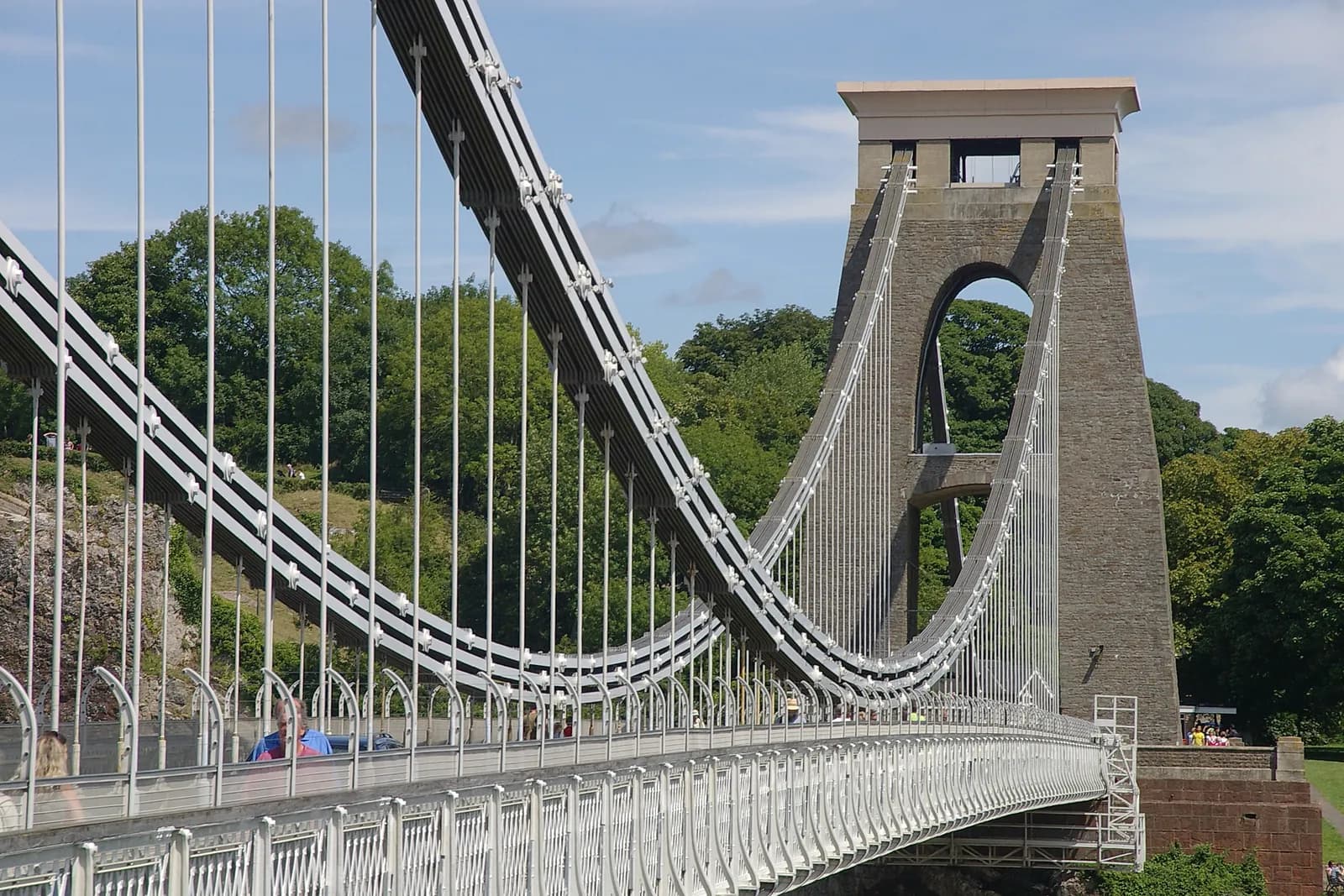
The Clifton Suspension Bridge connects Clifton in Bristol with Leigh Woods in North Somerset across the Avon Gorge. The idea originated in 1753 with a bequest from Bristol merchant William Vick, and by 1829 the fund had grown to £8,000. A design competition followed; Thomas Telford initially rejected all entries, but a second competition in 1831 declared Brunel the winner, and construction began on 20 June 1831 with blasting at St Vincent's Rock. Work halted four months later due to the Bristol riots, which damaged commercial confidence and cut subscriptions to the bridge company. Construction resumed in 1836 after the Great Western Railway Act restored some financial confidence, but funds ran out by 1843, and the ironwork was later sold for use on Brunel's Royal Albert Bridge. Following Brunel's death in 1859, colleagues at the Institution of Civil Engineers raised funds to complete the bridge as a memorial, using chains from his demolished Hungerford suspension bridge in London. A revised design by William Henry Barlow and Sir John Hawkshaw featured a wider, higher, and sturdier deck with triple chains. Work restarted in 1862, and the bridge was ceremonially opened on 8 December 1864, 111 years after its initial conception and five years after Brunel's death. It remains a Grade I listed toll bridge, with the Clifton Suspension Bridge Trust now responsible for its preservation.
Bristol's Enduring Engineering Identity
These three projects established Bristol as a centre of Victorian engineering ambition. Temple Meads remains the busiest station in South West England; the SS Great Britain draws visitors to the harbour as a museum ship; and the Clifton Suspension Bridge continues to carry traffic across the Avon Gorge. Together, they form a physical narrative of innovation, setback, and eventual triumph that still defines the city's character.